
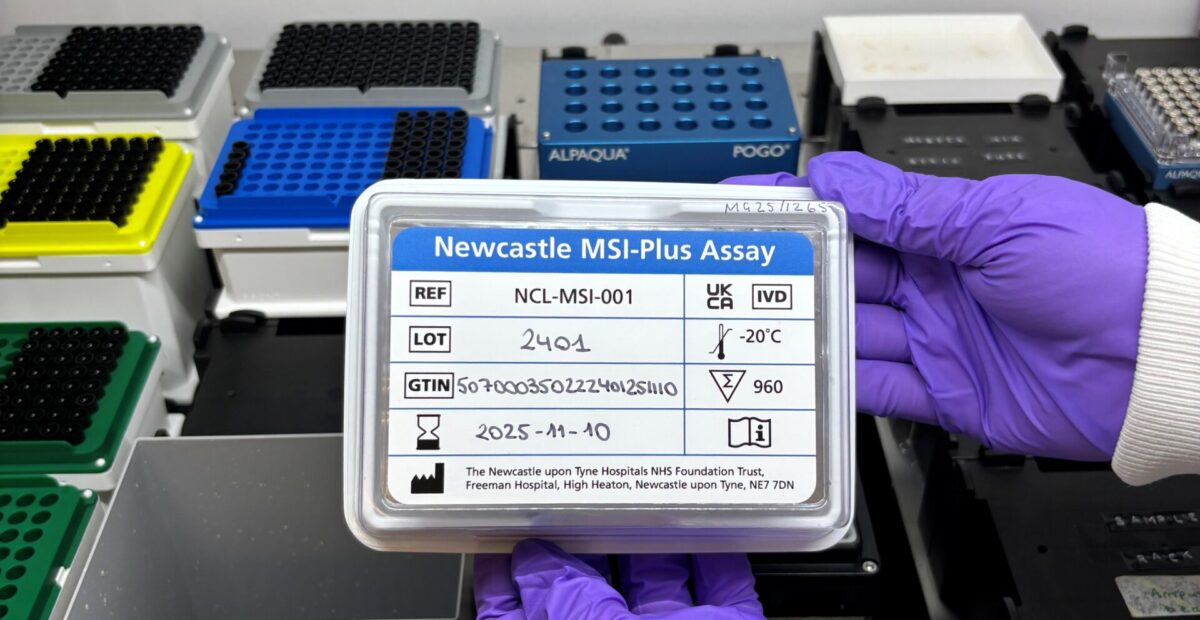
An innovative genetic screening test created in the north east is now being rolled out for patients elsewhere in the country.
Designed by a team of scientists from Newcastle Hospitals and Newcastle University led by Professor of clinical genetics, Sir John Burn.
The test is being used in genomics labs for patients across west Yorkshire and the Humber, and Bristol in the south west. This follows the north east and north Cumbria where the test has been used since 2022.
Screening for Lynch syndrome means that if a person tests positive, a DNA test can then be offered to their relatives to see who else has the condition, so they can be put on a regular programme of checks.
The MSI plus assay detects a pattern of chemical changes on DNA which can indicate the condition. It is the first product of Newcastle Hospitals to be UKCA-marked, meaning it is certified to be sold in the UK.
Dr Ciaron McAnulty, clinical scientist at Newcastle Hospitals, said:
The test has significantly improved how we identify people at risk of Lynch syndrome, with faster screening enabling more patients to be diagnosed in a shorter time frame, resulting in better monitoring of those at higher risk of developing cancer.
We have successfully translated this ‘exemplar’ test from its beginnings in a research lab, through to the front line of care for patients.
This is a testament to the close collaboration between scientists and researchers working together.
Meeting recommendations by the National Institute for Health and Care Excellence, the test is being used by scientists in some of NHS England’s genomics laboratory hubs across the country.
Julien Deckard, 56, of Ingleton near Darlington, has had bowel cancer three times in the last fifteen years and has had multiple surgeries and chemotherapy at the Freeman Hospital in Newcastle. He was tested for Lynch syndrome and found to be positive.
It’s five years that I had an operation to remove cancer for the second time. It was then that I was tested for Lynch syndrome, and I was advised that my children could be carriers as well
One of my daughters tested positive and she’s now monitored regularly. Whilst it’s sad I’ve passed this on, it’s reassuring that there’s regular monitoring and early detection for my family if they need it.
It was good to know about this and have more information about the increased risk of colorectal cancer. I’m monitored regularly with blood tests every three or four months and I have a CT scan every year.”
Last year the team won an award from Cancer Research Horizons, the innovation arm of Cancer Research UK, in recognition of their impact in transforming diagnosis for patients.
Alessia Errico, associate director of search and evaluation at Cancer Research Horizons, said of the award:
We named the MSI plus assay as our Translational Project of the Year because it exemplifies the kind of innovation that can truly transform patient care.
The Newcastle team’s work is a model for how research and clinical practice can come together to improve outcomes for people affected by cancer.
Ready for use
- The MSI plus assay is registered as an in-vitro diagnostic medical device with the Medicines and Healthcare Products Regulatory Agency (MHRA).
- The test is commercialised with a UKCA marker.
- It has received UKAS ISO 15189 accreditation.
Early research published in The Lancet has also shown that the test is also effective in identifying urothelial cancers linked with Lynch syndrome. The team is working to develop this and the test is available for use in research in this area.
The test for lynch syndrome in people with bowel cancer is now available for use
The test for detecting urinary tract cancers in people with lynch syndrome is available for research